What is a traditional VAC Dressing and Pump?
A traditional V.A.C. (Vacuum Assisted Closure) Dressing uses suction from the pump to encourage the wound to heal faster than other types of dressings. It uses VAC technology, which is the suction action that helps the wound heal. This is also known as Negative Pressure Therapy.
During your dressing changes, you may have noticed that foam is shaped to fit your wound and placed inside. It’s then securely covered with a special adhesive film to seal the area and prevent leaks and infection. Please avoid pulling or disturbing the edges of the dressing. If the dressing comes away from your skin, it will create a hole, called a "leak," which can cause the suction to stop working.
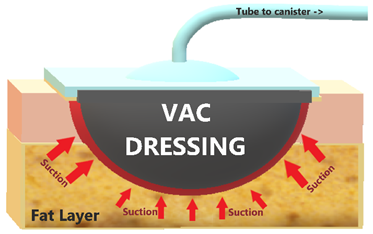
This diagram demonstrates how the suction (negative pressure) encourages the wound to heal quicker
This is your pump:
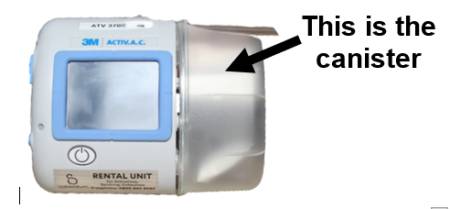
The pump is a device that helps remove fluid from your wound by pulling it into a clear canister connected via a tube to the dressing.
If you need to replace the canister, pause the pump, unscrew the tubing from the dressing, push the plastic lever down on the outside of the canister to release it. Then simply push the new canister (provided on discharge) into place until you hear it click, rescrew onto dressing tubing and unpause the pump.
It's important to make sure your pump is always working. You’ll know it’s working when the dressing is tightly "vacuumed down" and the screen or lights on the pump are on. Never turn off the pump and always check that the battery is charged in case of a power outage.
Do the following:
- DO keep the dressing and pump clean and dry – so avoid taking a shower. Even steam can encourage the edges of the dressing to lift
- DO keep the pump charging overnight and whenever you’re sat down to keep it fully charged
- Do take good care of your pump, as it is expensive for us to fix them
- Contact help (see phone numbers overleaf) if you have any concerns. However, if you notice that your canister has suddenly filled with a large amount of fresh bright red blood and you believe the wound is bleeding rapidly and heavily please call 999 for an ambulance.
Don’t do the following:
- DON’T let the edges of the dressing peel. If they peel back the dressing won’t work!
- DON’T turn the pump off or let the battery run out.
If the pump has not been running for more than 2 hours the entire dressing may have to be changed. If this has happened, please see “if you have any concerns or problems”.
What happens next:
As you may have already learned, the dressing needs to be changed twice a week. The hospital nurse will have already arranged for the District Nurse to visit you at home to change the dressing. The District Nurse may also change the pump to another type of pump.
If you live near the hospital, in the Nuneaton area, the district nurses may change your pump for a new one. If this happens, please keep the old pump and call the Tissue Viability Team at George Eliot Hospital on 02476 153609. Leave a message with your name and the date the nurses changed your pump. We will then arrange for the company to collect the old pump from your home. They will contact you to arrange a date and time for pickup.
If you have any concerns or problems
- If the pump has not been working for longer than 2 hours the dressing will need to be changed by the district nurses – please contact them directly.
- If there is a “leak” please use the adhesive film (should have been provided on discharge) and stick it over where the suspected leak is.
- If the canister is full, please follow the instructions above.
- Alternatively, if your issue cannot be resolved, please call:
- During working hours only Monday to Friday: The George Eliot Hospital Tissue Viability Nurses: 02476 153609
- Outside of normal working hours: The company (Solventum) that provides the pumps: 0800 980 8880
*This number is also on the silver sticker on the front of the pump
- Or attend George Eliot Hospital Accident and Emergency department. Please take this leaflet with you.
George Eliot Hospital is a smoke free environment. For help and advice to stop smoking you can call the national helpline on 0300 123 1044 or visit https://
Copyright
Except where otherwise noted, this item is licensed under the CC BY license (https://
If you are a rights holder and are concerned that you have found material on our patient information resources website, for which you have not given permission, or is not covered by a limitation or exception in national law, please contact us using the Feedback form providing your contact information and full details of the material.