
On behalf of the George Eliot Hospital NHS Trust, we extend our sincere sympathy to you and your family at this sad time.
This booklet aims to provide useful help and advice to assist you during the early days of your bereavement. Please do not hesitate to ask if you are not clear about anything. Our staff will always be pleased to help you.
The George Eliot Hospital NHS Trust seeks to meet the needs of all members of our community when someone close to them has died. If you have any religious, cultural or other needs, please tell us.
Please contact the Bereavement Service Office:
George Eliot Hospital
024 76865102
Monday to Friday, 8:30am to 4:30pm
Please contact the Bereavement Service Office to confirm that the death certificate has been completed. We will explain the process for issuing the Medical Certificate of Cause of Death.
Steps to take following your bereavement
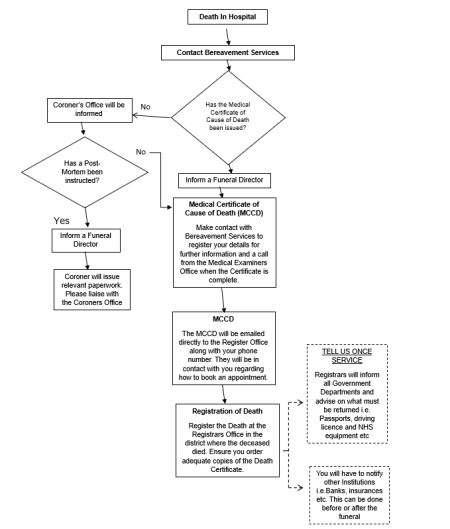
Section 1 - Practical Issues
Introduction
This booklet provides help and advice with the practical issues associated with the loss of a relative or friend, particularly if the death has occurred in hospital.
Practical Necessities - What to do first
Following the death of a relative, or friend in hospital there are certain things which need to be done.
You will need to contact the hospital Bereavement Services Office on
024 7686 5102.
You will need to contact a funeral director. You don’t have to wait until the "Death Certificate" is issued before doing this. However please check the Certificate is going to be issued before setting a firm date for the funeral. This is because it is sometimes necessary for the Coroner to become involved.
Before finalising the funeral arrangements you should find out if the deceased made a Will and consult the solicitors who hold it (where applicable), to see what the deceased’s wishes were regarding funeral arrangements. The Will also provide the names of the executors or the persons legally entitled to deal with the deceased’s estate. The solicitors will assist you with the administration of the estate and any questions relating to tax issues that may arise.
Paperwork Needed after a Death
The Bereavement Services Office is here to help you with the paperwork. Our contact number is 024 7686 5102.
When someone dies in hospital there is paperwork that needs to be completed to comply with the law. All deaths need to be registered and for this the relatives need to make an appointment with the Registrar of Births, Deaths and Marriages. The MCCD is e-mailed via the Medical Examiner’s Office and the Registry Office will make contact with you regarding making an appointment to register the death. You do not have to come to the hospital to collect any paperwork.
Please do not book an appointment to register until the Medical Certificate is completed.
The Registrar then issues a Certified Copy of the Death Certificate
The Medical Certificate of Cause of Death
This is issued by a Doctor who cared for the patient at the Bereavement Office. Once this is completed, a Medical Examiner who is independent to the patients care, reviews this to confirm and check all information is correct. This is then sent directly to the Registry Office via e-mail so you no longer collect this from the Bereavement Office. The Registry Office will then make contact with you.
The George Eliot Hospital Bereavement Services Offices can be contacted Monday – Friday 8.30am – 4.30pm (excluding Bank Holidays) on the numbers on the inside front cover and staff will be pleased to help and advise you.
If large amounts of money have been entrusted to the hospital for safekeeping, this will have to be banked and will be returned to the next of kin via a cheque, or alternatively to the deceased’s solicitor or Executor of the Will.
Unfortunately, it is not possible to store property after 30 days and arrangements should be made for collection before this time, otherwise the property will be disposed of by the Trust.
We aim to have everything completed as quickly as possible but there are sometimes delays which we cannot control.
The Bereavement Services Officer will need to know:
- The full name of the deceased.
- Your relationship to the deceased.
- Main occupation of the deceased patient when they were working.
- If known, whether the funeral is to be a burial or cremation (where there is a Will you can check this for instructions).
- Your contact telephone number (if you have one), home address and email.
When the death certificate is issued by the Doctor, you will need an appointment to register the death. The death certificate is sent directly to the Registry Office and the Registry Office will make contact with you to make an appointment to register the death. The address of the Nuneaton Registry Office is:
Riversley Park, Coton Road, Nuneaton, CV11 5HA
Tel. 0300 555 0255
The following documents are helpful to take with you when registering, but if you do not have these, it will not stop the registration going ahead.
· Medical Card
· Birth Certificate
· Marriage Certificate
Following completion of the registration, you will be given:
· Department of Social Security Form (if in receipt of a pension or allowance)
There is a charge for each certificate you obtain. These may be needed for bank and insurance purposes.
Tell us Once
When someone dies it can be an upsetting and stressful time. The Tell Us Once program reduces the amount of time you need to spend contacting government department and organisations, because you provide all the information to the Registrar at the end of the death registration appointment. This information is then forwarded on to the Department of Work and Pensions (DWP) who will then inform the relevant government departments.
Alternatively, you may wish to ring DWP yourself following your death registration appointment. If this is the case your Registrar will provide you with the telephone number.
Who May Go and Register a Death?
Regulations state that only certain people can register a death with the Registrar of Births, Deaths and Marriages:
· A relative of the deceased who was present at the time of death.
· A relative of the deceased, in attendance during the last illness.
· A relative of the deceased residing in the same local district.
· A person present at the time of death.
· The occupier, eg the Matron or Officer in Charge of a nursing home or rest home,
provided they knew of the illness before the death.
· The person arranging the funeral, eg an executor, solicitor or similar.
Your Visit to the Registry Office
You will be able to purchase a Certified Copy of An Entry Certificate (Death Certificate), which is needed for any private pension claims, insurance policies and financial matters; normally one or two copies would be sufficient.
“A Certificate of Registration of Death” (known as the "White Form"). This is for Social Security purposes only.
Tell Us Once
The Registrar will explain how you can use the “Tell Us Once” service to inform central and local Government departments about a death. This service will save you having to write or telephone each service individually. The Registrar will advise you which Government departments can be notified.
Fees to correct Registration Entries
Please note that any changes to a registration once you have signed the register page will be subject to a Government enforced fee. Please be certain that the information you provide to the Registrar and spellings are correct at the time of registration.
There are three main reasons why a case is referred to the Coroner:
· A death has been sudden and unexpected.
· A person has been ill but the doctor confirming the death is not certain why it
happened at that particular time.
· A death has been caused as a result of an accident or unusual circumstances.
The Coroner will look at the case and decide what happens next. He or she may request a post-mortem examination to determine the exact cause of death. The Coroner may give permission for the hospital Doctor to issue the Medical Cause of Death Certificate or an inquest may be required.
Where the death is reported to the Coroner, particularly when the GP has not been involved e.g. deaths in the hospital Emergency Department, then you may receive a visit from the Police. The reason for this is that Police Officers also act as Coroner’s Officers and they will be visiting you in order to gain further details of the deceased, next of kin etc, which they will pass on to the Coroner.
The staff at the Coroner’s Office are very helpful and will answer any questions you may have. They will contact you as soon as possible in order to discuss details relating to your relative or friend.
The address is:
The Coroner’s Office Warwickshire Justice Centre
Newbold Terrace
Leamington Spa
CV32 4EL
Coroner’s Office Opening Hours:
Monday to Friday 8.00am – 4.00pm
Weekends and Bank Holidays - Closed
Telephone: 01926 738409/ 01926 738410/ 01926 738411/ 01926 738412/ 01926 738413/ 01926 412542
You will only need to visit the Coroner’s Office if you are asked to do so.
Provided that there is no Coroner’s involvement, the Medical Certificate of Cause of Death will be issued by a Doctor at the Hospital, and you will be contacted by a member of the Medical Examiners Office. The Medical Certificate of Cause of death is not the formal Death Certificate. This is produced by the Registrar of Births, Deaths and Marriages when you register the death.
Hospital Post-Mortem
Occasionally a hospital doctor may request a post-mortem examination to be performed.
Please scan the QR code below for the information.

Medical Examiner
Who are medical examiners and medical examiner officers, and what do they do?
Scan QR code for information or simply click on the link below.
https://

The choice of a funeral director is important, as you should feel comfortable and confident with them.
If you need any support choosing a funeral director the National Association of Funeral Directors will be able to advise you (see the ‘Advice and Support’ section on page 17). Their code of practice is approved by the Office of Fair Trading.
You can ask any funeral director for an estimate of cost in advance of making any commitment to using their services. It is reasonable to ask for at least two firms to quote a cost for you to compare, as charges can vary considerably.
Cremation
A deceased cannot be cremated until the cause of death is known. There are certain forms that need to be completed but the Bereavement Services Office will organise this on your behalf. These forms are collected by your funeral director. The local authorities set the costs of the cremation forms.
Ashes can be scattered in a garden of remembrance or in a favorite place, although you will require permission from the landlord or person responsible for the land before doing this. Ashes can be buried in a churchyard or cemetery, or they can be kept. Your funeral director can organise this for you.
Burial
The cost of a grave space can vary. The costs will normally be higher for the burial of someone who lives outside the Council or Parish boundary for the chosen cemetery. If a grave space has been paid for in a cemetery, there will be a Deed of Grant.
Your funeral director can advise you of the fees for a burial.
Financial Help
If you receive certain Social Security Benefits (for example, Income Support, Housing Benefit and others) you can apply to the Social Fund for help to pay for the costs of the funeral.
You will need to complete an Application Form SF200. This is available from your local Jobcentre Plus or by download from their website (www.jobcentreplus.gov.uk). There is a leaflet included with the form, which explains how to complete it and where to send it.
You must include a written quotation, provided by your funeral director, with your application.
There are various people and organisations that need to be told about the death. The following organisations will be informed if you use the “Tell Us Once” service:
· The local Inland Revenue Office.
· The local Social Security office to cancel pensions, allowances, benefits etc. You will get a special form from the Registrar’s Office to do this.
· Driver and Vehicle Licensing Agency (DVLA). Return the Driving Licence to the address on the licence.
· Passport Office. Return the passport to the office.
· Any library or clubs subscribed to by the deceased.
· If the deceased was receiving Housing Benefit/Council Tax Benefit, the local housing department.
Others to inform include:
· Solicitor. If there are any difficulties with legal issues or questions about the estate it is advisable to contact a solicitor or the Citizen’s Advice Bureau.
· Local social services if meals on wheels, home help or day centre transport was used. Also, NHS equipment, British Red Cross equipment etc. may need returning.
· Any hospital the deceased was attending for appointments.
· The deceased's GP.
· Bank/Building Society. If it is a joint account the partner can continue to draw cash. The Probate Office will advise on whether it is necessary to obtain Probate or Letters of Administration (see the ‘Advice and Support’ section).
· Employer or college should be informed if a parent, brother, sister, grandparent or other close relative or friend has died.
· Car insurance company. People driving a car insured in the deceased’s name are not legally insured.
· Any clubs subscribed to by the deceased.
· Gas, Electricity and Telecom companies, Royal Mail deliveries, local newsagent and milk deliveries (if applicable).
· If the deceased was living in rented accommodation the council or private landlord should be informed.
Section 2 - Help and Support
Grief is a very personal experience. What you experience in your grief is particular and specific to you. There are no rules or a ‘correct’ way to grieve. However, there are some feelings which are commonly experienced in grief. These notes may help you to understand your experience but it is not an exclusive list and you may not feel every one of these emotions.
Grief is complicated and can be a very frightening experience. You may have periods of confusion and/or forgetfulness. Some people feel numb or that they have low energy or limited motivation to complete normal daily activities. Please be kind to yourself: Maybe reduce the number or size of the tasks which you expect of yourself and allow yourself a little more time to complete jobs.
Some other very common feelings within your grief may be a feeling of anger. These feelings of anger may be expressed in many ways; towards the person who has died for leaving you or at others, such as family members, health care professionals or your own personal beliefs, leaving you with a feeling that you were unable to prevent the person from dying.
Some people feel relief that their loved one is no longer struggling in pain and others have difficulty accepting the loss and so have a sense of denial at the events surrounding the illness and/or death. There are often feelings of guilt for many different things said, done or left undone. Many people report that they feel an intense feeling of injustice and unfairness at their loss.
There is also no particular order to these feelings and you may not experience them all. It is important to know that there is no set time-frame for feelings of grief, nor a time-limit. The old saying that ‘Time heals’ does not always feel as if it applies in grief: It is possible that the swells of feeling which you experience will remain at the same intensity, even if the frequency of these waves is likely to decrease over time. The deep feelings of missing your loved one may continue for a very long time. Some people say that they continue to ‘see’ or ‘hear’ the one they have lost for what can feel like a lengthy period and others that they experience vivid dreams. If this happens to you, you may find it distressing but it is quite common.
It can feel like the world has moved on and forgotten you in your grief. It can help to recall happy memories and to talk to others who knew the person who died. This can provide comfort. It may be wise to avoid making important decisions whilst your grief still feels intense.
If you are struggling with your grief and you would like someone to talk to, there are a number of organisations which may be able to offer support. Some may offer counselling, others information and a few provide support groups. You may also wish to speak with your GP.
Advice and Support
It can sometimes be easier to talk to a stranger about things that you are going through than it is to talk to a person who is close to you.
If you would like further information or support, our Bereavement Support Service is available. If you have questions that you would like to raise about the care of your loved one the Bereavement Support Services team can help to find the answers or arrange for you to meet one of the ME’s, doctors or nurses.
You can contact them by email or phone:
Email: Bereavement
Phone: 024 76865102
The Trust offers a Counseling service which provides an opportunity to talk through what matters to you following your bereavement. The counselling service is available by appointment Monday – Wednesday, 8.30am – 4.00pm.
You may also wish to talk to a hospital chaplain. We have chaplains and volunteers from a variety of religious faiths and denominations. You can contact the Chaplaincy by email or phone:
Email: chaplaincy.
Phone: 024 76865046 (in hours), 024 76351351 (out of hours through switchboard)
The Chapel is on the ground floor past the x-ray department. It is a peaceful place and always open. There is a book for writing prayer requests and a place to light a candle. We also have a Book of Remembrance and we can arrange for you to have your loved ones name added by a professional calligrapher.
The Patient Advise and Liaison Service (PALS) is a service run by the hospitals to provide advice and help. You can also contact them if you wish to raise a concern or make a complaint about the care you loved one received.
You can contact PALS as follows:
Email: pals
Phone: 024 76351351
Patient Advice and Liaison Service
George Eliot Hospital
College Street
Nuneaton
CV11 7DJ
ADULT SOCIAL CARE
Phone: 01926 886922
AGE UK Coventry & Warwickshire offers information and advice to older people and their carers.
Phone: 024 76231999
National Helpline: 0800 009966
Website: www.ageuk.org.uk
ASSIST TRAUMA CARE provides a therapeutic service for family members traumatised as the result of homicide of a loved one.
Phone: 01788 560800
CHILD BEREAVEMENT CHARITY supports families when a baby or child of any age dies.
Phone: 01494 568900
Website: www.childbereavementuk.org
CITIZEN’S ADVICE BUREAU (NUNEATON & BEDWORTH) providing an information only service on a range of subjects such as legal issues and health.
Phone: 024 76494393
National Helpline: 0300 330 1163
COMPASSIONATE FRIENDS peer support group offering different kinds of support for bereaved families.
Phone: 024 76348011
CRUSE BEREAVEMENT CARE acts as a listening service for those or someone they know who has been affected by a death. They provide information on practical and financial matters and details of groups available.
Phone: 024 76670714
National Helpline: 0808 808 1677
Website: www.cruse.org.uk
DEPARTMENT FOR WORK AND PENSIONS (DWP)
Phone: 0800 1690190
MACMILLAN offers an online support community.
Website: www.macmillan.org.uk
MARY ANN FAMILY SUPPORT & BEREAVEMENT SERVICE provides confidential and high quality emotional support to individuals and their family members and friend.
Phone: 024 76865431
Email: geh.maryannclinical@nhs.net
Website: maryannevans.org.uk
NUNEATON REGISTRAR OF BIRTHS, DEATHS AND MARRIAGES
Phone: 0300 555 0255
PATIENT ADVICE & LIAISON SERVICE GEH providing help and advice for patient, relatives and carers.
Phone: 024 76865550 or 024 76865576
Email: pals@geh.nhs.uk
PROBATE HELPLINE
Phone: 0300 1231072
STILLBIRTH AND NEONATAL DEATH CHARITY (SANDS) offers support for anyone affected by the death of a baby.
Phone: 0207 4365881
SURVIVORS OF BEREAVEMENT BY SUICIDE is a self-help group that offers support to families and friends of those who have committed suicide.
National helpline: 0300 111 5065
Website: www.uksobs.org
THE COUNSELLING DIRECTORY helps people to find a private counsellor.
Website: www.counselling-directory.org.uk
THE GOOD GRIEF TRUST provides practical help and advice to newly bereaved.
Website: http://www.thegoodgrieftrust.org
THE SAMARITANS are available 24 hours a day to provide confidential emotional support for people who are experiencing feelings of distress or despair, including those which may lead to suicide.
National helpline: 116 123 (this number is free to call)
Website: www.samaritans.org
jo
THE VICTIM SUPPORT GROUP offers emotional and practical support to those who have been bereaved due to a crime that has been committed.
Phone: 0808 16 89 111
WIDOWED AND YOUNG is a self-help group created to offer support for those bereaved who are under 50. Their website offers helpful information about talking to children, the practicalities of planning the funeral and its aftermath. There is also the opportunity to join the organisation.
Website: www.widowedandyoung.org.uk
Remember, people really do want to help.
If you need to know how and where to find help,
our hospital staff will be pleased to assist you.
Section 3 - Some Terms Explained
Burial - the placing of a body in a grave.
Coroner - a public officer whose principal duty is to enquire into the cause of death where it has been sudden, unexpected or where there is reason to suppose that it might not be due to natural causes.
Cremation - to reduce the body to ashes by burning.
Death Certificate - an official document issued by the Registrar of Births, Deaths and Marriages when the death is registered at the Registry Office.
Funeral Director (also called undertaker) - someone whose business is preparing the body for burial or cremation and arranging and managing funerals.
GP - abbreviation for General Practitioner, the family doctor.
Medical Certificate of Cause of Death - an official document issued by a doctor, stating the date, place and cause of a person’s death.
Medical Examiner - a senior doctor (consultant) who looks at the medical notes and talks to the deceased’s family to see if any lessons can be learnt from the patient’s care.
Postmortem Examination - an examination of the body after death to determine the cause of death.
Registrar of Births, Deaths and Marriages - an official recorder of Births, Deaths and Marriages.
Will - a legal declaration of the manner in which somebody wishes to have their property disposed of after their death.
Section 4 - A Lasting Way to Celebrate a Life
Sending flowers has been a traditional way to show a mark of respect for a life now sadly passed. It can often feel difficult to adequately show your feelings of sadness and condolences in a way that is appropriate. An alternative thoughtful and meaningful gesture, in lieu of flowers, is a donation in their memory. A donation can help the ward, department or condition that is most personal to you. It will be spent in the area of your choice to improve the facilities and care for our patients, visitors and staff, helping us to provide the best possible service to all those in our care.
If you wish to make a donation, please make your cheque payable to "George Eliot Hospital Charity" and tell us the area your donation is to be spent or if it should be used in the area of greatest need.
If you have any questions or concerns, or would like further information about a donation in memory of someone special, please do not hesitate to get in touch with our Fundraising Co-ordinator on: 02476 153476 or GEHCharity
GEH Charity
Lewes House
George Eliot Hospital
College Street
Nuneaton
CV10 7DJ
Follow us on Facebook: www.
George Eliot Hospital is a smoke free environment. For help and advice to stop smoking you can call the national helpline on 0300 123 1044 or visit https://
Copyright
Except where otherwise noted, this item is licensed under the CC BY license (https://
If you are a rights holder and are concerned that you have found material on our patient information resources website, for which you have not given permission, or is not covered by a limitation or exception in national law, please contact us using the Feedback form providing your contact information and full details of the material.