This leaflet will help guide you as you get better after hurting your Achilles tendon.
What is an Achilles tendon rupture?
The Achilles tendon joins your calf muscles to your heel bone. These muscles help point your foot down, lift your heel when standing, and help you move forward when walking, running, jumping, or hopping. If you suddenly put too much pressure on the tendon, it might tear or snap. It can feel like someone kicked the back of your leg and might make a loud pop sound. This will make walking hard and your ankle may feel weak or floppy. A doctor or physiotherapist will check to confirm if this has happened.
Treatment
A torn Achilles tendon usually gets better with physiotherapy. First, the A&E team will put your leg in a hard cast called a back slab, or a boot. Within two weeks, you will wear a special boot called a VACOped boot. Both will hold your foot pointing down to help the tendon heal. You will need crutches to help you walk. The VACOped boot stays locked in this position for 4 weeks, and then we will adjust your boot at 4 weeks and 6 weeks to allow your ankle to move more. You must wear the boot all the time, even at night. You will wear it for 8–10 weeks.
Your physiotherapist will give you important home exercises and help you get back to work and sports.
Weight bearing guide.
If you are wearing a hard back slab, you will not be allowed to put any weight on your leg. This means you must not stand or walk on that leg at all.
Once you get the VACOped boot, you can start standing and walking with full weight on the leg.
0–6 weeks after getting the boot: You will wear a special tiptoe sole, and your foot will stay in a tiptoe position. You will still need elbow crutches.
6 weeks after getting the boot: You will switch to a flat sole. You might not need crutches anymore.
Using stairs.
At first, do not go up or down stairs while wearing the back slab unless a physiotherapist at the George Eliot Hospital has shown you how.
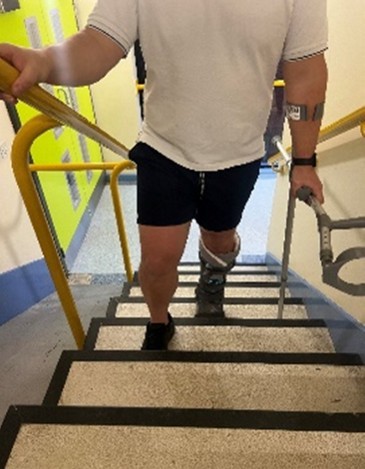
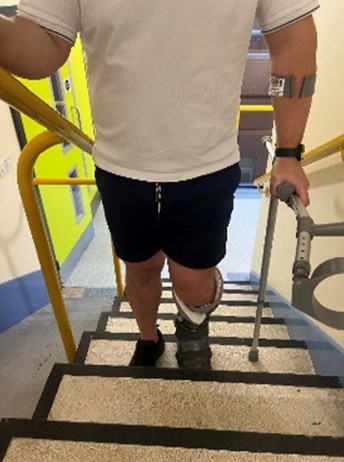
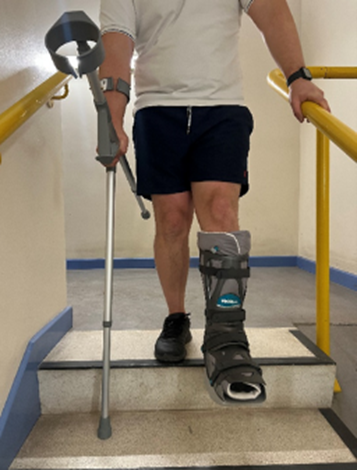
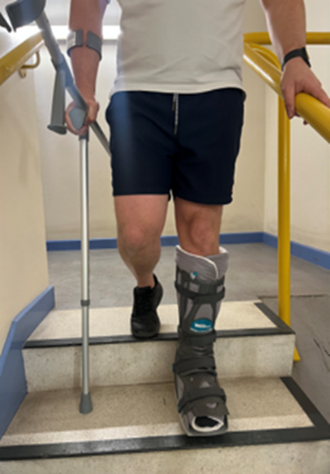
After getting the VACOped boot, go one step at a time and use the handrail if there is one.
Going up stairs: Step with your good leg first, then the bad leg, then elbow crutch.
 |
 |
Going downstairs: Put the elbow crutch down first, then your bad leg, then your good leg
 |
 |
Initial injury
You go to A&E. The A&E team will provide a below knee, back slab (a type of cast) with your foot pointing down. You will not be putting weight through this leg while standing or walking. You will be provided and taught how to use elbow crutches. You will get medicine to stop blood clots. The A&E team will book an appointment for you to be seen at fracture clinic.
2 weeks later
At fracture clinic, the plaster team will remove the back slab. The doctors will check you again and will send you to physiotherapy for a VACOped boot.
- VACOped boot is fitted & locked at 30° (Setting 3) (tiptoe position) with wedge sole. An even up sole is put on the other side shoe.
- You can now put weight through the leg while wearing the boot.
- You will still need to use elbow crutches.
- Boot treatment plan begins: First 4 weeks = full rest in boot
- Exercises given for your thigh and bottom muscles (not the calf)
4 weeks after getting the boot.
- Boot unlocked a little (between 15–30°) (Settings 1.5 - 3) with wedge sole.
- Begin safe movements and gentle muscle exercises out of boot (foot can only point down)
- No calf stretches.
6 weeks after getting the boot.
- Boot unlocked more (0–30°) (Settings 0 -3) with flat sole.
- Keep doing safe ankle movements and start using resistance bands (start with the easiest band & progress onto greater resistance)
- No calf stretches.
8–10 weeks after getting the boot
Start wearing shoes with a heel inside or trainers with a wedge sole when indoors. Your leg should feel okay—no limping or pain. Keep wearing the VACOped boot outside.
10-12 weeks after getting the boot.
Begin wearing your shoes with a heel raise or trainers with a wedge sole outdoors. Still wear the boot in busy or slippery places (for another 6 weeks).
12-16 weeks after getting the boot
Start using normal shoes again, including flat shoes, slippers, or bare feet.
Always bring your bag with the key, pump, clean liner, and soles to your appointments.
Before putting the boot on, shake and squeeze the cushion inside so it spreads out nicely. This helps make the boot comfier.
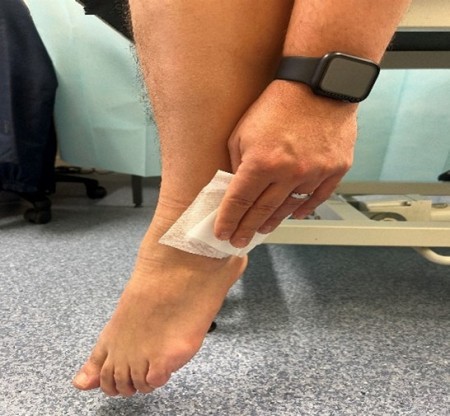
Follow the number order (1, 2, 3, 4) to tighten the bootstraps. If the boot rubs or hurts, use a soft plaster to protect the skin.
You can take the sole of the boot off before bed but put it back on before standing up or using the toilet at night. Never walk without the sole on.
To remove the sole, press the buttons on the sides of the boot. Push it back on until it clicks to lock.
You can wash the outer cloth liner. First, take out the white cushion inside. Zip it up and wash in the washing machine at 60°C.
Use an EVENup shoe lift on your good leg’s shoe to help you stand evenly.
Do not let the boot get wet in the bath or shower.
You can use a special waterproof cover - ‘shower protection leg’ when showering—be careful not to slip.
You can find more info, buy spare parts like liners, and covers at https:/
Check the FAQ booklet for more tips: FAQ-booklet_VACOped-OPED-UK.pdf
Your physiotherapist will give you a special exercise plan. Below are examples of the kinds of exercises you may be given as you recover.
0-2 weeks (if in plaster)
Do this while lying or sitting:
- Move your toes up and down 20 times.
- Tighten your thigh muscles 20 times.
- Squeeze your bottom muscles 20 times.
Do this 2-3 times every day.
At your physiotherapy appointment, you will get a special boot called a VACOped boot. It will keep your foot pointed down at a 30° angle (this is called setting 3).
You must wear this boot all the time (day and night) for four weeks. You can take it off once a day to clean your leg and foot with a strip wash and check your skin for any sore spots. While washing, keep your foot pointed down, do not move your ankle, and do not let your foot touch the floor.
Home exercises to do while wearing the boot
Lie on your back with your leg straight. Squeeze your thigh muscles and push the back of your knee into the bed.
Hold for 5 seconds. Do this 10 times. Once a day.
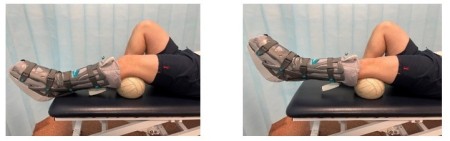
Lie on your back with a rolled-up towel or blanket under your knee.
Straighten your leg by lifting your foot up (your knee stays resting on the blanket).
Hold for 5 seconds. Do this 10 times. Once a day.
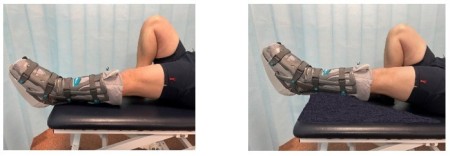
Lie on your back. Keep your knee straight by tightening your thigh.
Lift your leg about 30–40 cm up. Hold for 5 seconds, then lower it slowly.
Repeat 10 times. Once a day.
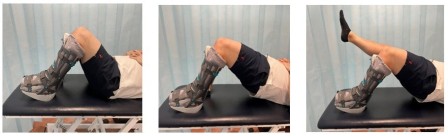
Lie on your back with your knees bent. Squeeze your bottom muscles and lift your hips off the bed.
Hold for 5 seconds. Do this 10 times. Once a day.
If this is easy, try lifting one leg at a time.
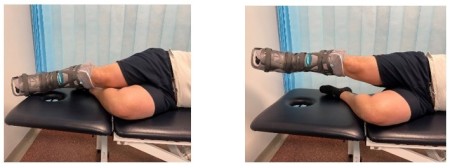
Lie on your side with your legs straight.
Tighten your tummy muscles. Keep your top leg straight and lift it up.
Hold for 5 seconds, then lower slowly. Do this 10 times. Once a day.
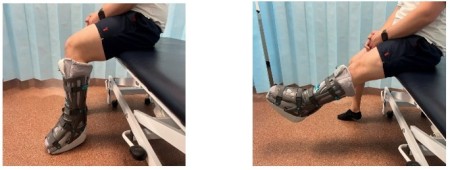
Sit on a chair or bed with your knees bent.
Straighten your leg out in front of you.
Hold for 5 seconds, then slowly bring it back.
Repeat 10 times. Once a day.
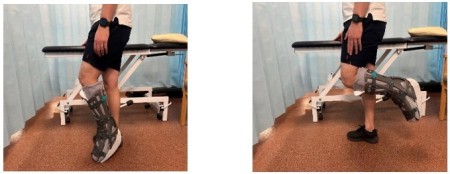
Stand and hold on to a counter or table.
Bend one knee, lifting your foot behind you.
Hold for 5 seconds, then lower slowly.
Repeat 10 times. Once a day.
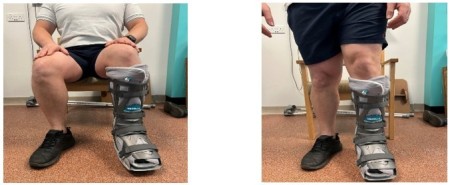
Practice standing up from a chair with your boot on.
Do this 10 times. At least once a day.
4 weeks after boot is put on.
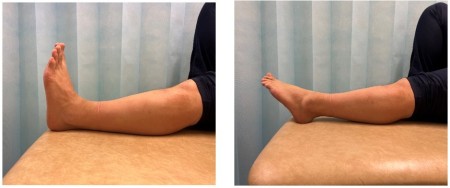
You can now start doing gentle ankle movements and calf muscle tightening. Do not stretch your calf.
Point your toes down as far as you can.
Tighten your calf at the end, hold 6 seconds then relax and return to start.
Do this 10 times, 3 times a day.
Don’t pull your toes up past the upright (vertical) position
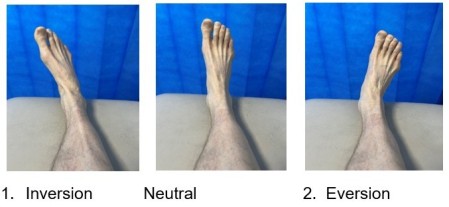
Turning foot in (inversion) – Picture 1
Keep your leg still and turn your foot inwards.
Do this 6 times, 3 times a day.
Do not pull your toes up past vertical.
Turning foot out (eversion) – Picture 2
Turn your foot outwards.
Do this 6 times, 3 times a day.
Do not pull your toes up past vertical.
6 weeks after boot is put on.
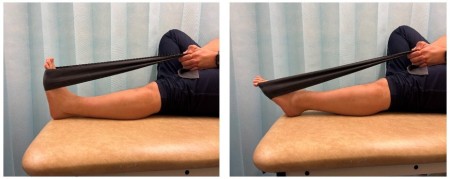
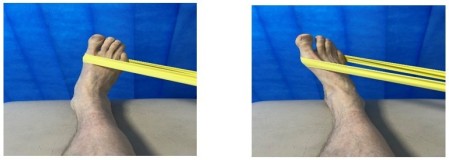
Keep doing gentle movements, now with stretchy bands (start with yellow/easiest & progress onto greater resistance as able).
No stretching.
Use a band to push your foot down. Tighten your calf at the end.
Slowly return to start.
Do this 10 times, hold 6 seconds, 3 times a day.
Don’t pull foot up past vertical.
Push your foot outwards against the band.
Do this 6 times, 2 times a day.
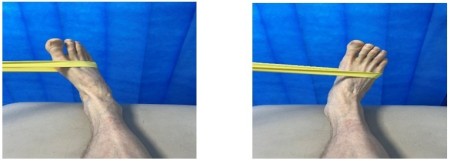
Push your foot inwards against the band.
Do this 6 times, 2 times a day.
8-10 weeks post boot application
Talk with your physio & if you feel ready - Start to wear trainers with a wedge sole or shoes with a heel raise inside your home for 2 weeks. Continue with the boots outdoors for 2 weeks. There is no rush to come out the boot. Continuing to strengthen your calf and Achilles has the most importance. Let your physio help you with this. Build up your walking slowly and use smaller steps. With stairs/steps lead with ‘bad’ leg and use banister
Your tendon is not yet strong, so do not do too much too soon.
Stop if anything hurts and tell your physio.
10-12 weeks post boot application
Talk with your physio & if you feel ready - Start to wear trainers with a wedge sole or shoes with a heel raise outside your home. There is no rush to come out the boot. Continuing to strengthen your calf and Achilles has the most importance. Let your physio help you with this. Build up your walking distance slowly and use smaller steps.
- Walk with heel-toe pattern
- Keep doing resistance band exercises lying down and increase resistance.
- If band exercises are ok, try lifting your heels with both feet off a book while sitting. Add weight if easy. Control lowering of heels to book. Do not stretch.
- Balance practice (standing on one leg)
- No stretches for your calf (unless guided by your physiotherapist).
- Gentle massage on your Achilles.
- Do NOT:
- Lift heel off a step until guided by your physiotherapist
- Stretch calf off a step.
- Do running, jumping, or hopping.
3 to 5 months after injury
- Try lifting both heels off the ground. Add weight if easy.
- Once that is easy, try lifting one heel off the ground.
- Once you can lift one heel off the ground – practice stepping down from a low step with the ‘good’ leg (make it higher as it gets easy).
- No calf stretches on step
- Balance on soft or moving things (foam, trampette).
5 to 6 months after injury
- Lift both heels while standing on a step holding onto support. Add weight if easy.
- Once that is easy, try with one leg.
- Try more challenging balance (wobble board, trampette).
- Jog on flat ground.
6 to 9 months after injury
- Start gentle sport exercises.
- Try small basic jumps and gradually increase as you feel ready
- Jog on a slope.
9 to 12 months after injury
- Run faster. Try turning (cutting/pivoting).
- Try small basic hops and gradually increase as you feel ready.
12 months after injury
- Return to your sport when you and your physio feel you are ready
Depending on your sport, age and level of injury it may take a year or longer to recover. Everyone is different.
Any problems, concerns or questions please telephone Physiotherapy on
02476 865036
George Eliot Hospital is a smoke free environment. For help and advice to stop smoking you can call the national helpline on 0300 123 1044 or visit https://
Copyright
All images and illustrations contained within patient information leaflets are the proprietary property of George Eliot Hospital NHS Trust. They are protected under copyright law. Any use, reproduction, or distribution of these images, in whole or in part, without the prior written consent of George Eliot Hospital NHS Trust is strictly prohibited.
Except where otherwise noted, this item is licensed under the CC BY license (https://
If you are a rights holder and are concerned that you have found material on our patient information resources website, for which you have not given permission, or is not covered by a limitation or exception in national law, please contact us using the Feedback form providing your contact information and full details of the material.